Is Tap Water Safe to Drink? How to Check Your Own Supply
Usually, yes. About 9 in 10 people in the US get tap water from a public system that must meet EPA limits for more than 90 germs and chemicals and warn customers about problems. Whether yours is safe depends on your utility's yearly report, your home's pipes, any active notice, and whether you use a private well.
You can check each of those for your own address, most of them online in a few minutes. Taste is a separate question, covered further down.
Is tap water safe to drink in the US? What the rules cover
The figures above come from CDC's water quality guide. EPA's drinking water regulations table lists every federal limit, from germs such as E. coli to chemicals such as lead. Utilities must test the water they supply regularly, and many states enforce rules at least as protective.
If there is an immediate health risk, the utility must tell you within 24 hours. Less urgent problems get 30 days or a year.
So where can it still go wrong? At the source or the treatment plant, which reports and notices cover, or in the pipes on your property, which the utility stops watching once water enters them. Private wells sit outside EPA's public water rules entirely.
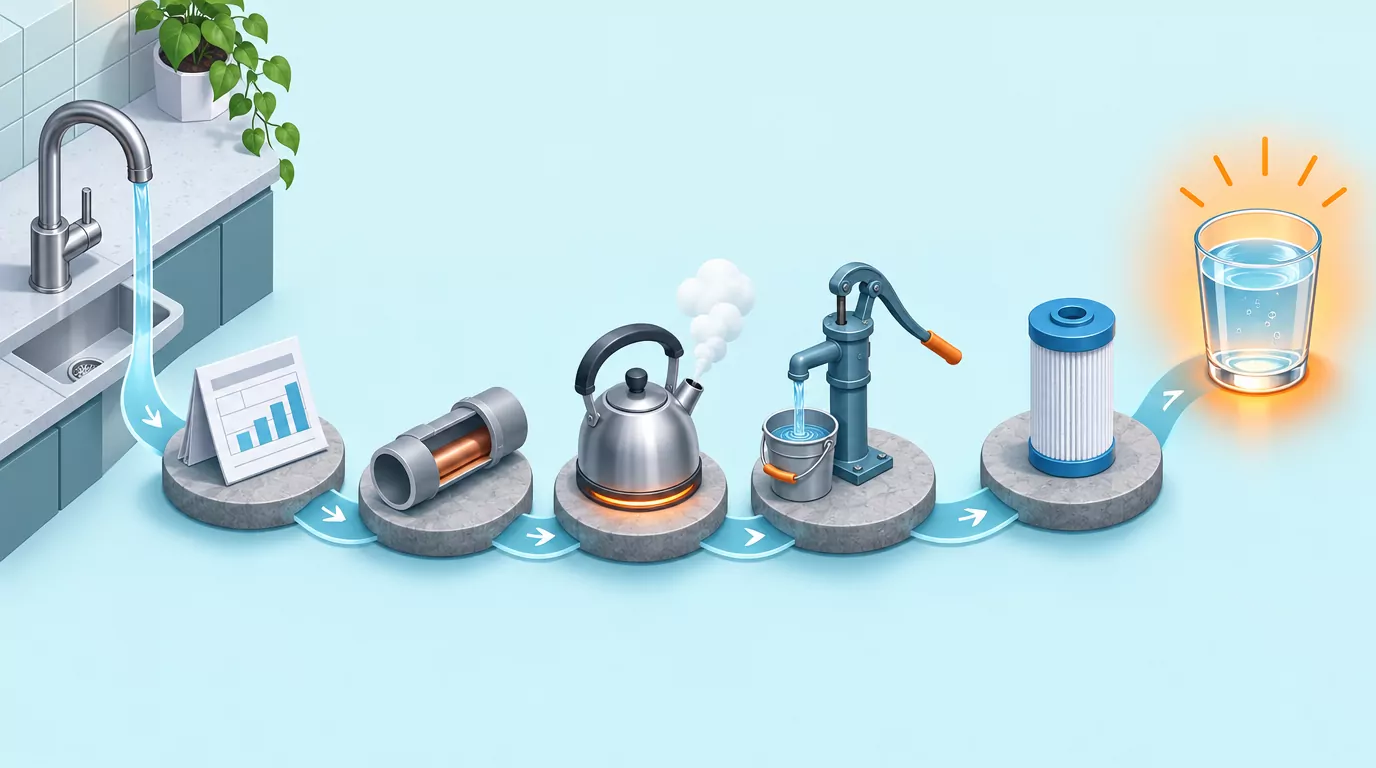
How to check your own tap water in five steps
On public water, the first two cover most homes. The other three matter when a notice goes out, when your water comes from a well, or when you are choosing a filter.
1. Find and read your Consumer Confidence Report
Every community water system must send customers a Consumer Confidence Report, or annual water quality report, by July 1 each year. Look for it with your bill, on the utility's website or through the search tool on EPA's CCR page for consumers.
If you do not know your supplier, check the bill or look up your address on EPA's water system service area map. That is the honest version of "is my tap water safe by zip code": find the system, then read its report. Renters who do not pay a water bill can check online or ask the landlord or building manager, as CDC's guide to reading water quality reports suggests.
There is no report for a private well, or for a hospital, school or other place with its own system. If you do get one, read it in this order:
- Start with the violations column, which may be called "meets standard" or something close.
- Compare each level with the MCL. The MCL is the enforceable limit. The MCLG is a health goal that can be zero, so a level above the goal but below the limit is not a violation.
- Units vary: 1 ppm equals 1 mg/L, or 1,000 ppb. Arsenic, for example, has an MCLG of 0 and an MCL of 0.010 mg/L (10 ppb), so a reading of 3 ppb is above the goal but below the limit, and not a violation.
- Read the violations section. It should say what happened, how long it lasted, whether it was a health risk and how it is being fixed.
- Find the lead and copper rows and the source water, such as a river, a lake or wells.
- Read the health information. It says who is at higher risk of illness from germs in water, and some reports list local resources for testing your water for lead.
- Compare with last year. A repeat problem matters more than a single blip.
Chlorine often appears as a contaminant: it is the disinfectant, helpful at the right levels, per CDC. Questions can go to EPA's Safe Drinking Water Hotline at 800-426-4791.
2. Check your service line and old plumbing for lead
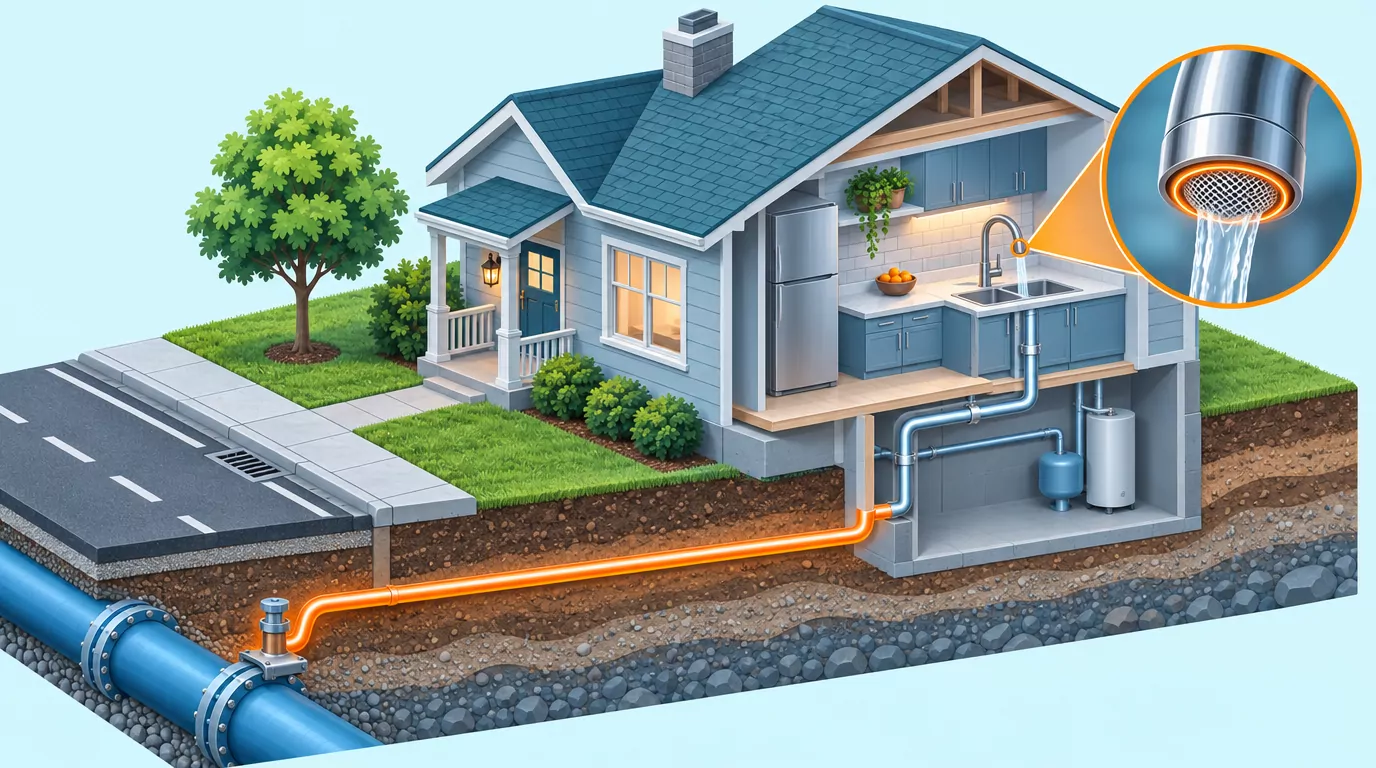
Lead gets into water when plumbing that contains lead corrodes. EPA says a lead service line, the pipe from the water main to your home, is typically the biggest source. Lead pipes are more likely in older cities and homes built before 1986.
Without a lead line, the usual problem is brass or chrome-plated brass faucets and lead solder. EPA and CDC agree there is no known safe level of lead in a child's blood.
EPA's short list:
- Ask your utility whether your service line is lead, or use EPA's Protect Your Tap guide.
- Use only cold water for drinking, cooking and making baby formula. For warm water, heat cold tap water in the kettle.
- If water has sat in the pipes for hours, run the tap, shower or do laundry first. Your utility can say how long.
- Clean the faucet aerator, the small screen at the tip.
- If you use a filter, make sure it is certified to remove lead, and change the cartridge on time.
You cannot see, taste or smell lead, so testing is the only sure way to know. It is most worth doing in a home built before 1986, or where babies and young children drink the water. EPA suggests asking your utility about having your water tested, and your state or local drinking water authority lists certified labs. EPA's basic facts on lead in drinking water cover the rest.
3. Know the three kinds of drinking water advisory
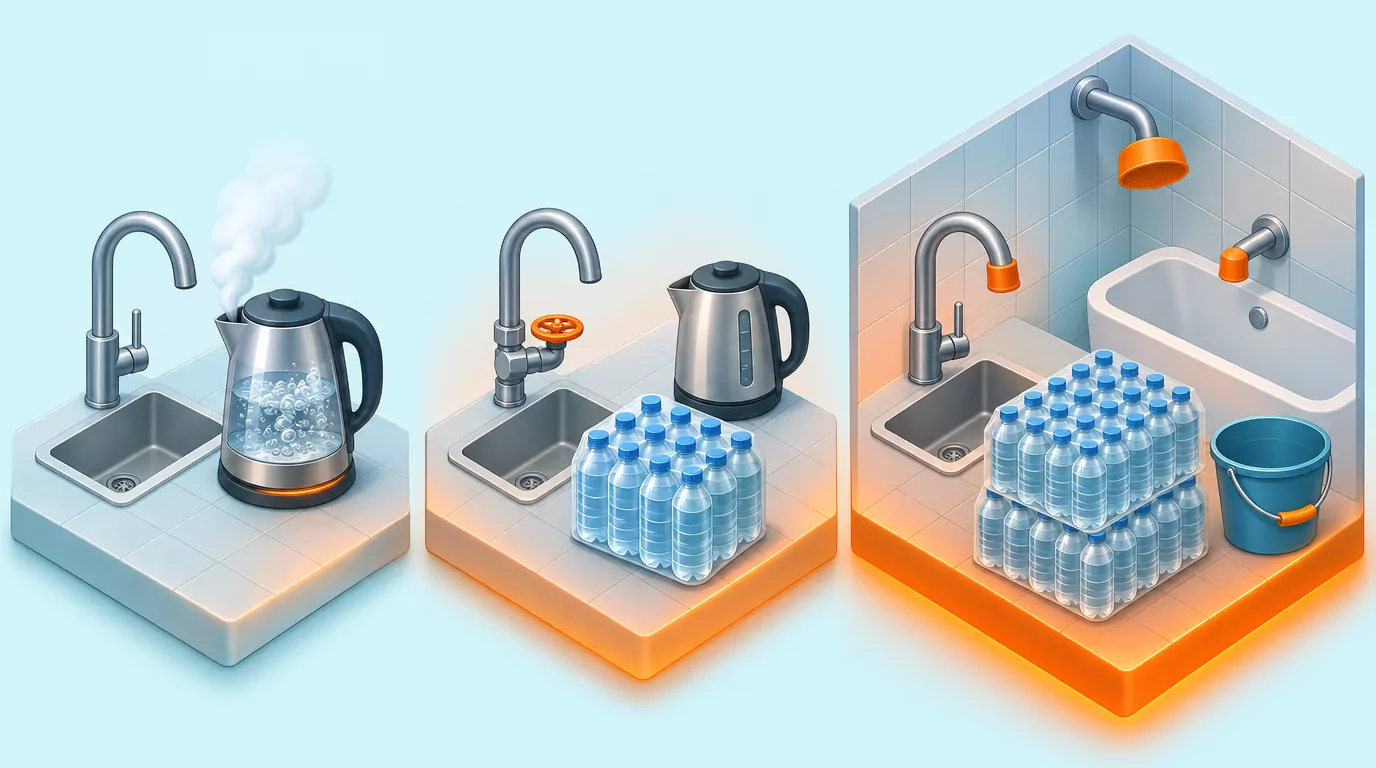
CDC names three kinds of drinking water advisory. A boil water notice is the common one. The other two are rarer and stricter.
| Advisory | What it means | What to do |
|---|---|---|
| Boil water | Germs may be in the water | Use bottled water, or bring tap water to a full rolling boil for 1 minute (3 minutes above 6,500 feet) and let it cool. Use it for drinking, cooking and brushing teeth. For baby formula, CDC suggests ready-to-use formula. Boil even if you filter. |
| Do not drink | Harmful chemicals or toxins may be in the water | Use bottled water for drinking, cooking, brushing teeth and mixing formula. Boiling will not make it safe. |
| Do not use | Any contact with the water could be harmful | Use bottled water for everything until the advisory ends. |
During any advisory, skip the fridge's water and ice dispenser too. On a boil water notice, CDC says you can still do laundry as usual and, in many cases, wash your hands with soap and tap water. Shower without swallowing any water, and consider a sponge bath for babies and young children.
Sign up for your utility's alerts if it offers them, and check its website after a nearby main break or flood. Keep a few sealed bottles at home for days like these, and check how long stored water keeps.
4. On a private well? Testing is your job
Nobody regulates, treats or monitors private well water for you, so testing is the owner's job. If no one pays a water bill for your home, ask whether it runs on a well.
CDC's guidelines for testing well water say to test at least once a year for total coliform bacteria, nitrates, total dissolved solids and pH. Add anything your health department flags for your area, and use a state-certified lab. Test again if the color, taste or smell changes.
Your health department can help you read the results, and EPA's hub on private drinking water wells has more.
5. Choose a filter for a reason, not a feeling
If your water has no harmful germs or chemicals, you may not need a filter. CDC's advice on choosing a home water filter is to read the report or test first, then pick one for the specific thing that worries you.
Most pitcher and fridge filters are not designed to remove germs; they mainly use carbon to improve taste or cut metals like lead. Read the box for a specific claim, such as lead, PFOA and PFOS, or chlorine, and check it in NSF's contaminant reduction claims guide. A bare "NSF certified" does not say what it reduces. The guide sorts certified products by contaminant and filter type: for nitrate, for example, it lists only reverse osmosis systems.
PFOA and PFOS are two PFAS, a group of chemicals that some reports now list and EPA's PFAS page explains. Reverse osmosis removes more, including some minerals and fluoride, per CDC's page on home water treatment systems. Filters can also take out useful things, like the chlorine that keeps germs down. Change cartridges on schedule and never run hot water through one.
Taste, smell and color are not the same as safety
CDC says taste, smell and look are not always good signs of safety. Harmful germs and chemicals often change none of them, while harmless things like some sulfur compounds can make water smell bad.
| What you notice | What it usually is | What to do |
|---|---|---|
| Chlorine or pool smell | The disinfectant doing its job | Fine to drink. For the taste, see below. |
| Metal taste after the water sat | Water that stood in older pipes | Run the cold tap first. |
| Rotten egg smell | Often sulfur: unpleasant rather than harmful | Tell the utility if it keeps happening. |
| Brown, orange or cloudy water, or any sudden change | Disturbed pipes or a supply problem | Do not guess. Call the utility before you drink it. |
If safe water still tastes like a pool, try these fixes for tap water off-tastes.
Tap or bottled: a quick way to decide
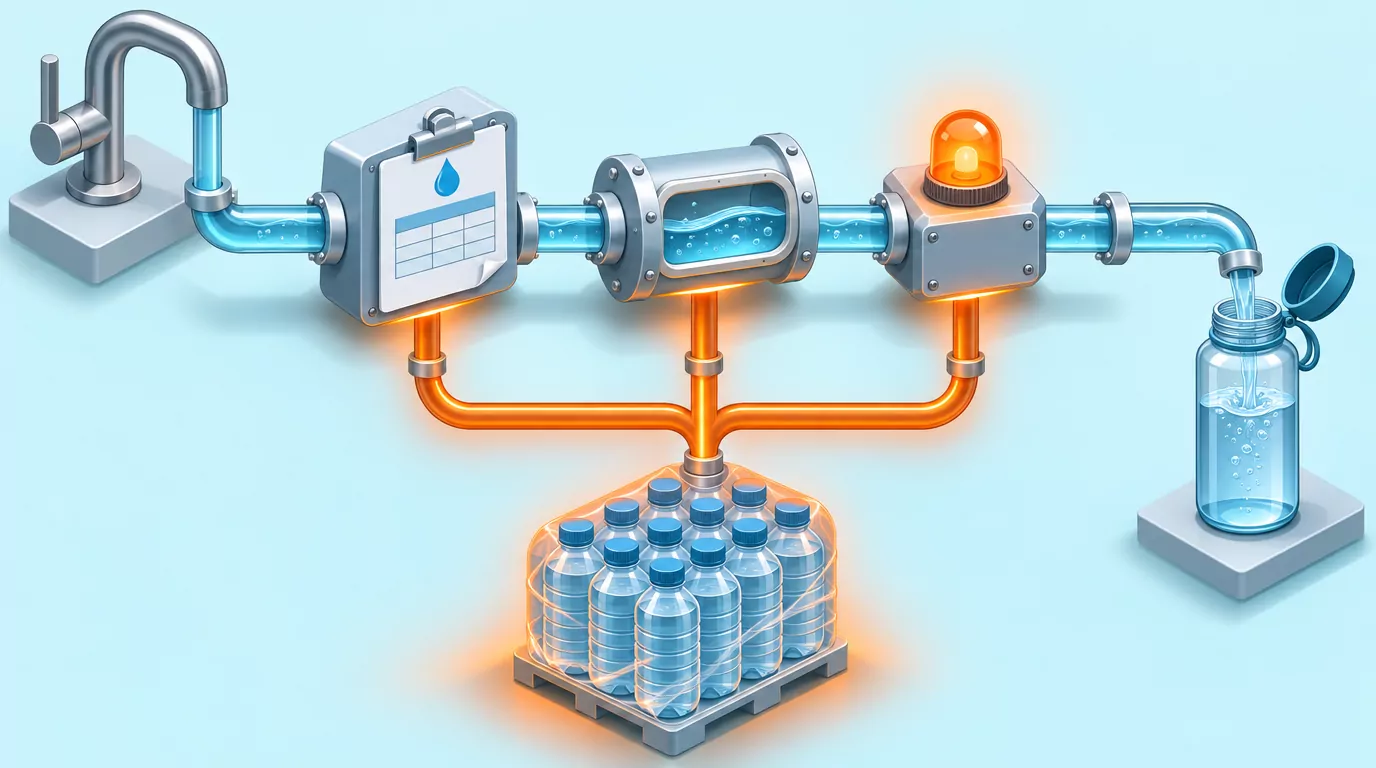
If your report is clean, there is no advisory and your pipes are not lead, tap water is a sound everyday default. Bottled water earns its place during an advisory, while a well test is pending, or anywhere the tap is not safe.
For how water types compare, and whether bottled beats tap at all, see this guide to distilled, purified, spring and tap water.
Frequently Asked Questions
Does boiling tap water purify it?
Boiling kills germs if the water reaches a full rolling boil for 1 minute, or 3 minutes above 6,500 feet, according to CDC. It does not remove lead, as EPA points out. That is why a do not drink advisory calls for bottled water, not the kettle.
Is bathroom tap water safe to drink?
In most homes both taps share one supply, so the water is the same. What differs is the fixture and anything fitted to one faucet, such as a kitchen filter. If you are unsure, clean the aerator, run the cold tap first, or use the kitchen tap.
Does tap water contain fluoride?
Often, at a low level. Many community systems add it, some do not, and practice varies by place. Your Consumer Confidence Report lists the level if it was found, and EPA's regulations table lists an enforceable limit of 4.0 mg/L.
Is hard water safe to drink?
Hard water is mostly dissolved calcium and magnesium. USGS calls hardness a nuisance rather than a health concern: think soap film and scale in the kettle. It also notes that WHO says drinking water can add some calcium and magnesium to the diet.
Refill from the tap and keep the habit easy
Once your tap checks out, a bottle filled at the sink is the cheapest, easiest hydration habit going. Keep it fresh with these steps to clean a water bottle, and borrow a few ways to drink more water if yours sits full on the desk.
For a daily number, try the water intake calculator. Water Goose handles the running total:
- A suggested daily goal from your age, gender, height and weight: a starting point, not a prescription.
- Logging in three steps: choose a drink, swipe to the amount, tap one clear button. Coffee, tea and soup count too.
- A history calendar of daily totals and streaks, with entries stored locally on your device and no account needed.
This is general wellness information, not medical advice; if something in your water worries you, your utility or local health department is the right first call.
Fill it at the tap, and let the goose keep count. Water Goose is on the App Store for iPhone and on Google Play for Android.