Simple Living in Practice: Fewer Moving Parts in an Ordinary Day
Simple living means running an ordinary day with fewer moving parts: fewer commitments you did not choose, fewer tools doing overlapping jobs, fewer interruptions, and small defaults that settle routine decisions once. It is a practice rather than an aesthetic, and it looks different for everyone.
This guide is the practical version. You will count your moving parts, cut a few, check your tools, and try a one-week plan, with honest notes on what the evidence does and does not show.

What simple living means, and what it does not
Simple living is about load. Every commitment, app, inbox and open decision needs a little tending, and a day can hold only so much of that before it feels crowded.
It is not austerity, a look, or a plan to quit your job. You can keep your work, your comfort and a full fridge. In practice it is small: one calendar instead of three, and a glass by the kettle instead of an hourly nudge to remember to drink water.
The idea is old. Quakers have long kept a testimony of simplicity, Thoreau wrote "Simplify, simplify" in Walden (1854), and later writers called it voluntary simplicity.
The evidence is encouraging but limited. A systematic review by Hook and colleagues in The Journal of Positive Psychology found 23 studies and a consistent positive link between voluntary simplicity and well-being. A link is not proof, though: happier people may simply find it easier to simplify.
Simple living, slow living and minimalism
The three ideas overlap, so people use them as if they were one. The quickest way to tell them apart is to ask what each one reduces.
| Idea | What it reduces | What it is about | A typical first step |
|---|---|---|---|
| Minimalism | Possessions | Owning fewer, better-chosen things | Clear one drawer or shelf |
| Slow living | Pace and rushing | Doing things with more time and attention | Eat one meal a day away from a screen |
| Simple living | Load: commitments, tools, inputs, decisions | Fewer moving parts to maintain | Count your moving parts and drop one |
So on simple living vs minimalism: a minimalist lifestyle counts things, while simple living counts upkeep. You can own very little and still run a frantic week.

Start by counting your moving parts
Take ten minutes and four lists. Write down everything that needs you on a normal weekday, then look for overlap.
- Commitments (5): a daily stand-up, a weekly team lunch, a book club, and two busy group chats.
- Tools and subscriptions (6): two calendars, two to-do apps, a notes app, and a meal-planning app you stopped opening.
- Inputs (5): a work inbox, a personal inbox, two news apps and one social feed.
- Recurring decisions (4): breakfast, what to cook, when to shop and what to wear.
That is twenty moving parts before anything unusual happens. Now remove five: leave the quieter group chat, merge the calendars, delete one to-do app and the meal planner, and keep one news app.
Fifteen parts is still a full day. But each one left is there on purpose, which is the whole point of intentional living.
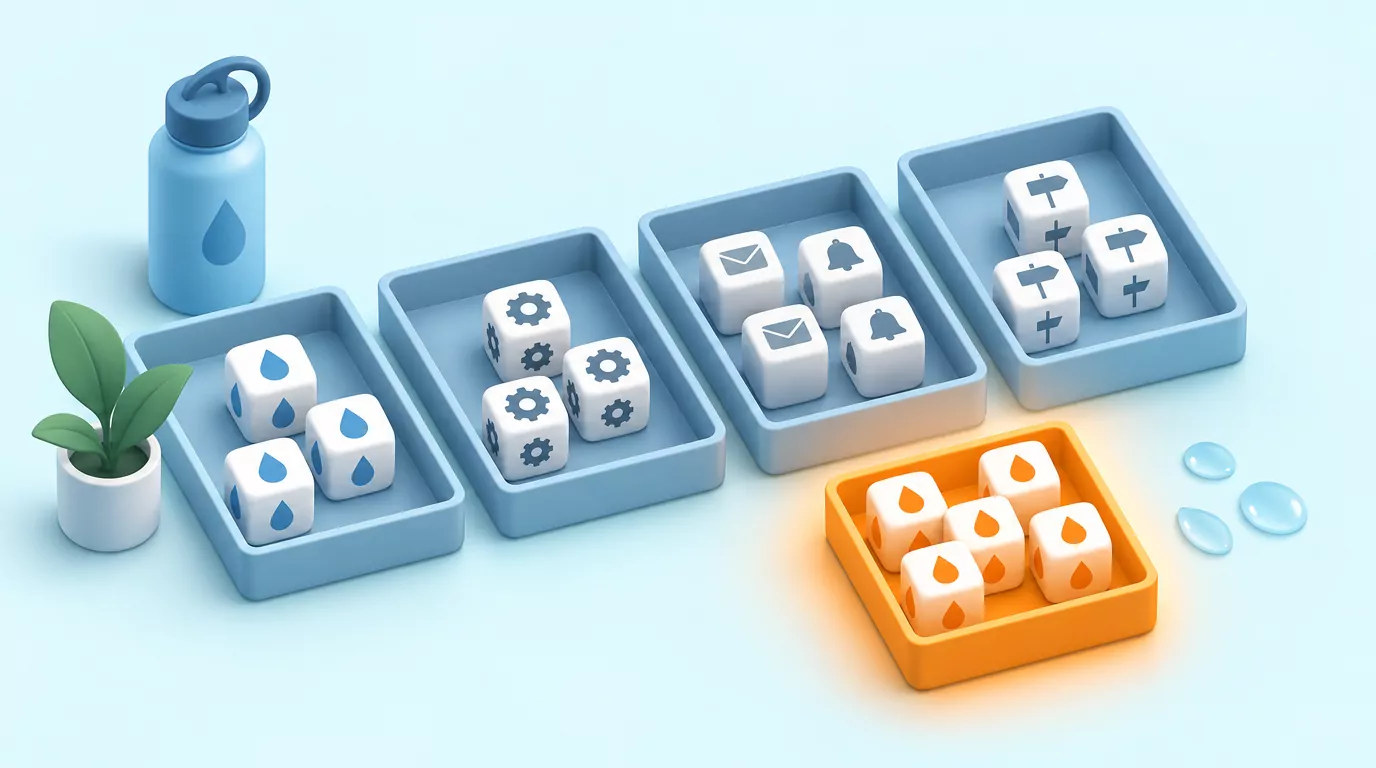
Fewer commitments
Trim the recurring ones first
One-off plans end on their own. Recurring ones stay until someone stops them: standing meetings, group chats that expect replies, memberships with duties attached.
Pick one and ask whether you would sign up for it today. A default reply helps with new asks too: "Let me check and get back to you tomorrow."
Leave one evening unscheduled
A calendar with no slack breaks the moment anything runs late. Leave one evening a week with nothing in it, on purpose.
It is not laziness and it is not a reward. It is spare capacity, and you get to decide on the day what fills it, if anything.
Fewer tools, each doing one job
Digital minimalism is mostly about tools. Before you keep an app or a gadget, run it through five questions:
- Does it do one job you actually need done?
- Does it open fast enough to use in the moment?
- Can you use it without making an account?
- Does your data stay on your device?
- Could you stop using it tomorrow without losing anything you need?
Paper passes all five, and so does the notes app already on your phone. For drinks, a Printable Water Tracker gives you daily and weekly sheets with no email or sign-up.
Water Goose is one example of a one-job app: it logs what you drink. Presets cover water, sparkling water, coffee, tea, milk, juice and soup, and a saved custom amount for your usual mug is a small default in itself. History shows daily totals, goal completion and streaks, and entries stay on the device with no account needed.

Fewer interruptions
Alerts are the loudest input, and the three-bucket notification audit deals with them in one sitting.
The other inputs need defaults rather than rules. Check email at set times, pick one news source, and open feeds on a schedule instead of whenever the phone is in your hand.
Small defaults instead of elaborate systems
A default is a decision you make once, so you stop making it daily. Here are five simple living tips that work this way:
- The same weekday breakfast. Replaces "what should I eat?" at the busiest hour.
- A glass by the kettle. Replaces "have I had anything to drink yet?" and makes drinking water in the morning automatic.
- One shopping list in one place. Replaces "what do we need?" and the second trip.
- One calendar. Replaces "which calendar was that in?"
- A weekly ten-minute reset. Replaces a week of small loose ends with one short look ahead.
Treat these as conveniences, not science. A 2010 meta-analysis of 50 choice overload experiments found an average effect of virtually zero, with big differences between studies.
Repetition is where defaults earn their keep. Gardner, Lally and Wardle's "Making health habitual" describes habits forming when you repeat an action in the same context until it becomes automatic. That is also why tracking water intake works best kept light.
A one-week starting plan
If you want to know how to live a simpler life without a big overhaul, try one small action a day for a week.
| Day | One small action | Rough time |
|---|---|---|
| 1 | Count your moving parts in four lists | 10 minutes |
| 2 | Drop one recurring commitment | 5 minutes |
| 3 | Remove three apps you have not opened in a month | 5 minutes |
| 4 | Quiet the alerts that only serve the app | 20 minutes |
| 5 | Set one default, like breakfast or one list | 5 minutes |
| 6 | Leave a gap: one evening with nothing planned | None |
| 7 | Notice what changed, then keep or undo each cut | 10 minutes |
Undoing a cut is allowed. The plan is a test, not a vow.

When simplifying becomes another project
Simplifying has a way of growing its own admin. People buy organisers to get organised, turn a morning routine into a spreadsheet, or keep a streak long after it became a chore. If that last one sounds familiar, there is a calmer way to keep a streak.
Buying something is not the problem. A dishwasher or a refill delivery that removes a chore is fine. The test is simple: after the change, do you have fewer things to maintain, or more?
Frequently Asked Questions
How do I start living a simpler life?
Start by counting, not cutting. Spend ten minutes listing your commitments, tools, inputs and recurring decisions, then remove the two or three that overlap most.
Add one default, like the same weekday breakfast, and leave one evening unplanned. For broader ideas on feeling well, the NHS lists 5 steps to mental wellbeing, such as connecting with people and learning new skills, as general suggestions.
Do I have to get rid of most of my things?
No. Decluttering belongs to minimalism, and it can help if your things take a lot of upkeep. Simple living looks at load first: what you have to remember, answer, update or decide each day.
Many people find their crowded calendar costs them more than a crowded cupboard. Clear a shelf if you like, but start with the parts of your week that keep asking for attention.
Does simple living mean using less technology?
Not necessarily. It means fewer tools doing overlapping jobs, and fewer of them able to interrupt you.
A phone can make life simpler when each app does one clear job, opens fast and keeps your data on the device. The goal is not a flip phone. It is a home screen where every app has earned its place and nothing asks for more than it gives.
Can you live simply with kids or a demanding job?
Yes, and that is often where it helps most. You cannot cut the school run or a deadline, but you can cut what surrounds them: a second calendar, a third group chat, a nightly debate about dinner.
Defaults do most of the work here, because they hold up on tired days. Aim for fewer moving parts, not an empty schedule.
Is simple living about spending less money?
Sometimes it works out that way, but money is not the measure. Some people spend more to simplify, like paying for something that removes a weekly chore.
Others spend less, simply because they buy fewer things to look after. The useful question is whether a purchase leaves you with fewer things to maintain, not whether it was the cheaper option.
Fewer things to tend
Simple living is not a lifestyle to buy into. It is a running count of what needs you, and the habit of keeping that count a little lower than it was.
This article is general wellness information, not medical advice.
If you would like one of your daily tools to be a one-job app, Water Goose for iPhone and Android logs your drinks and keeps entries on your device. You can find Water Goose on the App Store and on Google Play.