How Long Can You Go Without Water? Days, Not Weeks, and Why It Varies
How long can you go without water? About three days is the rule of thumb, but the range is wider: hours during hard exercise in the heat, a week or more for an adult in comfortable surroundings. "Without water" means without any fluid, since coffee, tea, soup and food supply it, and mild dehydration shows up long before any limit.
Most people asking will never get anywhere near that limit. The version that does happen is a busy day when you forget to drink water, and the second half of this guide covers it.
How long can you go without water? About three days, give or take a lot
You may have heard the "rule of threes": roughly three minutes without air, three days without water and three weeks without food. It is a memory aid, not a law of the body.
The middle number still works as a rough guide. Medical News Today gives about three days as a general rule of thumb.
So how long can a human go without water in practice? There is no single answer, biologist Randall K. Packer explains in Scientific American, because so many factors decide it. Someone exercising hard in hot weather can dehydrate and overheat in a few hours, while an adult in comfortable surroundings can survive a week or more with no water or very little.
The window is short because water is most of you. A review of water and health by Popkin and colleagues, hosted by the NIH, notes that people can survive only for days without it. Water makes up about 75% of body weight in infants and about 55% in older adults.
One note on scope: this guide is about healthy adults in everyday life. When someone at the end of life stops drinking, that is a different situation, and their care team is the right people to ask.
What "without water" actually means
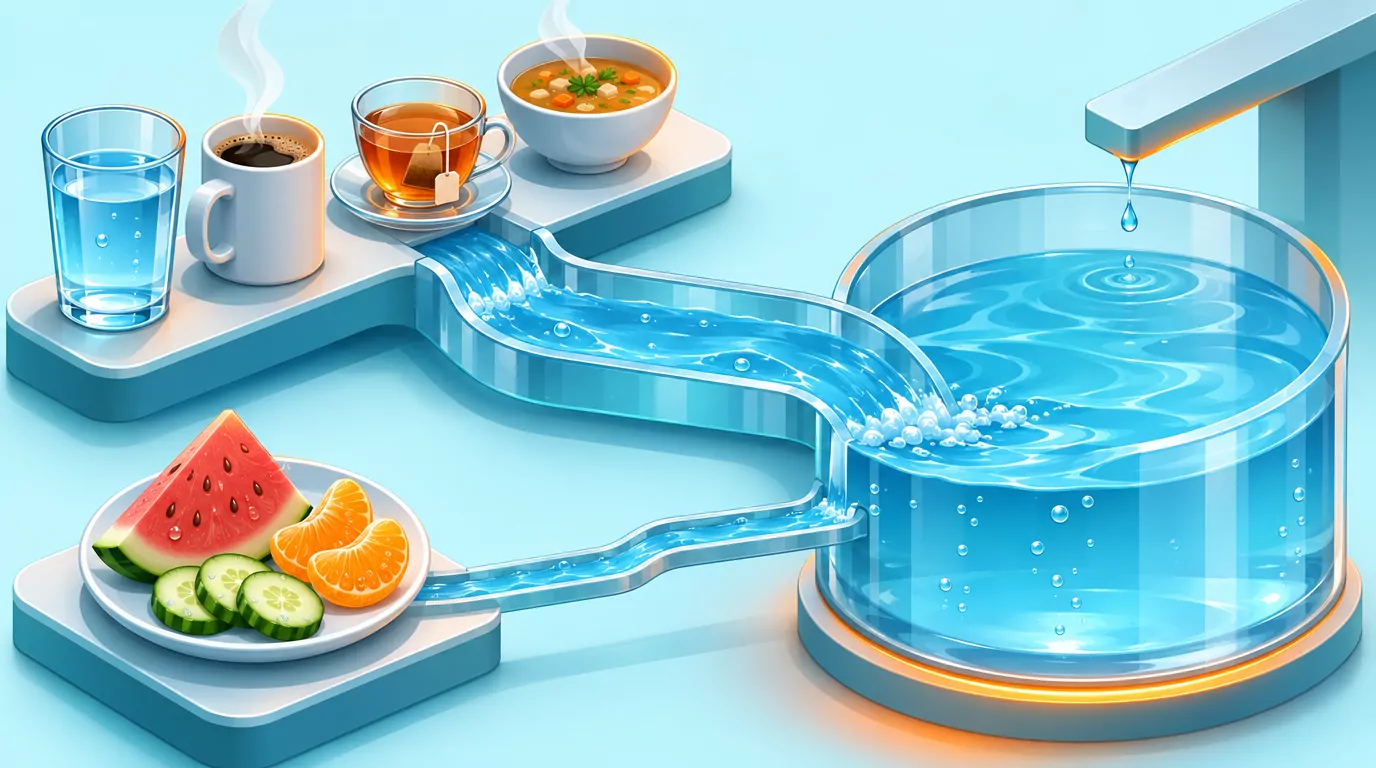
Your body does not count glasses of plain water. It counts total water, from every drink and from food. The National Academies found that about 80 percent of people's total water comes from drinking water and other drinks, caffeinated ones included, and about 20 percent comes from food.
That changes the question. Someone drinking coffee, tea or soup through the day is not going without water in the sense people mean, even if they never touch a glass of plain water. The case for coffee is in does coffee count toward water intake, and more everyday swaps are in how to stay hydrated without drinking water.
Food adds real water too. Fruit, vegetables and soups carry a lot of it, as the water content of 32 common foods shows, while very dry, salty food adds little. For how different drinks stack up against plain water, see the hydration index of common drinks.
Your body also makes a small amount of "metabolic water" as it breaks down food, according to Popkin and colleagues. It is real but tiny, and nowhere near enough to replace drinking.
What happens without water, roughly day by day
Nobody can give exact hours for this, and no careful source tries. As a rough frame, Medical News Today describes thirst and mild sluggishness on the first day with no water, and organ failure by about the third.
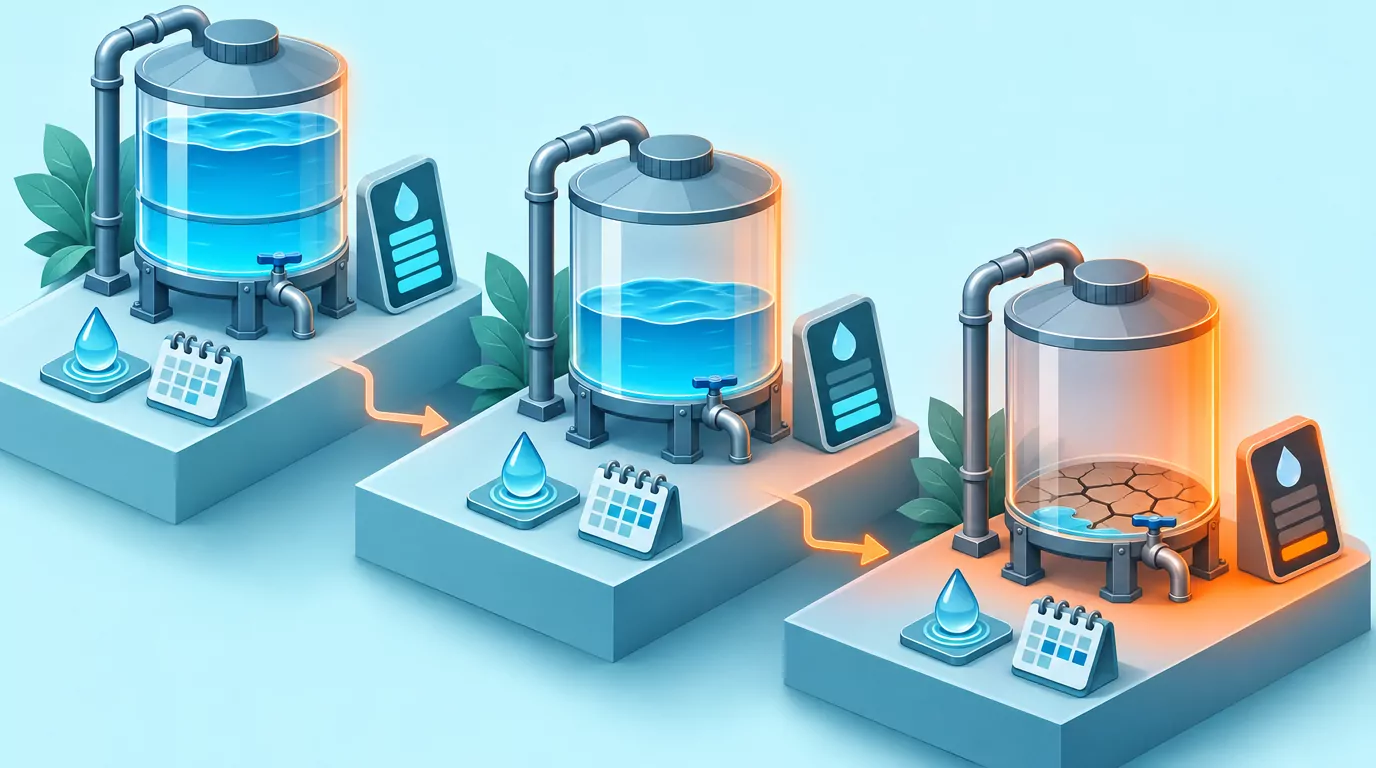
BBC Future, drawing on fluids researcher Dileep Lobo, stages it by water lost instead of by day. The day labels in the table are Medical News Today's rough framing, not BBC's, so read it as a sequence rather than a schedule.
| Stage and rough timing (Medical News Today) | What the body is doing (BBC Future) | What you would notice |
|---|---|---|
| Early, often the first day | About 2% of body weight lost; the kidneys send less water to the bladder | Thirst, dry mouth, tiredness, a headache, darker urine |
| Middle, often the second day | Blood thickens and the heart works harder; at about 4%, blood pressure can drop | Stronger thirst, dizziness or lightheadedness, possible fainting |
| Late, by about day three | About 7%: blood flow to organs such as the kidneys and gut slows, causing damage | Confusion, very little or no urine, a medical emergency |
Heat and hard activity can move every row much earlier, in the worst cases to within hours.
Early: thirst, often on the first day
Thirst arrives first. In BBC Future's staging it starts at about 2% of body weight lost, when the kidneys send less water to the bladder. MedlinePlus and Cleveland Clinic list the other usual early signs: a dry mouth, tiredness, a headache, and darker urine that comes less often.
Thinking can slip already. BBC Future notes that losing 2% or more of body water can impair short-term memory and vigilance. A night's sleep is the everyday version of this stage: seven or eight hours with nothing going in, a mild gap and not an emergency, which is why drinking water in the morning feels so good.
Middle: the body struggles, often on the second day
Thirst gets stronger, and dizziness or lightheadedness can start. As the blood thickens, the heart and blood vessels work harder to keep blood pressure up. The kidneys hold on to water by making less urine.
At about 4% of body weight lost, BBC Future says, blood pressure can drop and fainting can happen. The body is still coping at this point, but only just.
Late: organ damage, by about day three
At about 7% of body weight lost, the body protects blood pressure by slowing blood flow to organs such as the kidneys and gut, and that causes damage (BBC Future, quoting Lobo). Medical News Today lists the complications that can follow, including altered mental status, kidney failure, low blood pressure, shock and, without water, death.
MedlinePlus calls severe dehydration a life-threatening emergency. This is general wellness information, not medical advice: if you or someone with you is confused, faint, barely urinating or cannot keep fluids down, get medical help right away.
What shortens or stretches the window
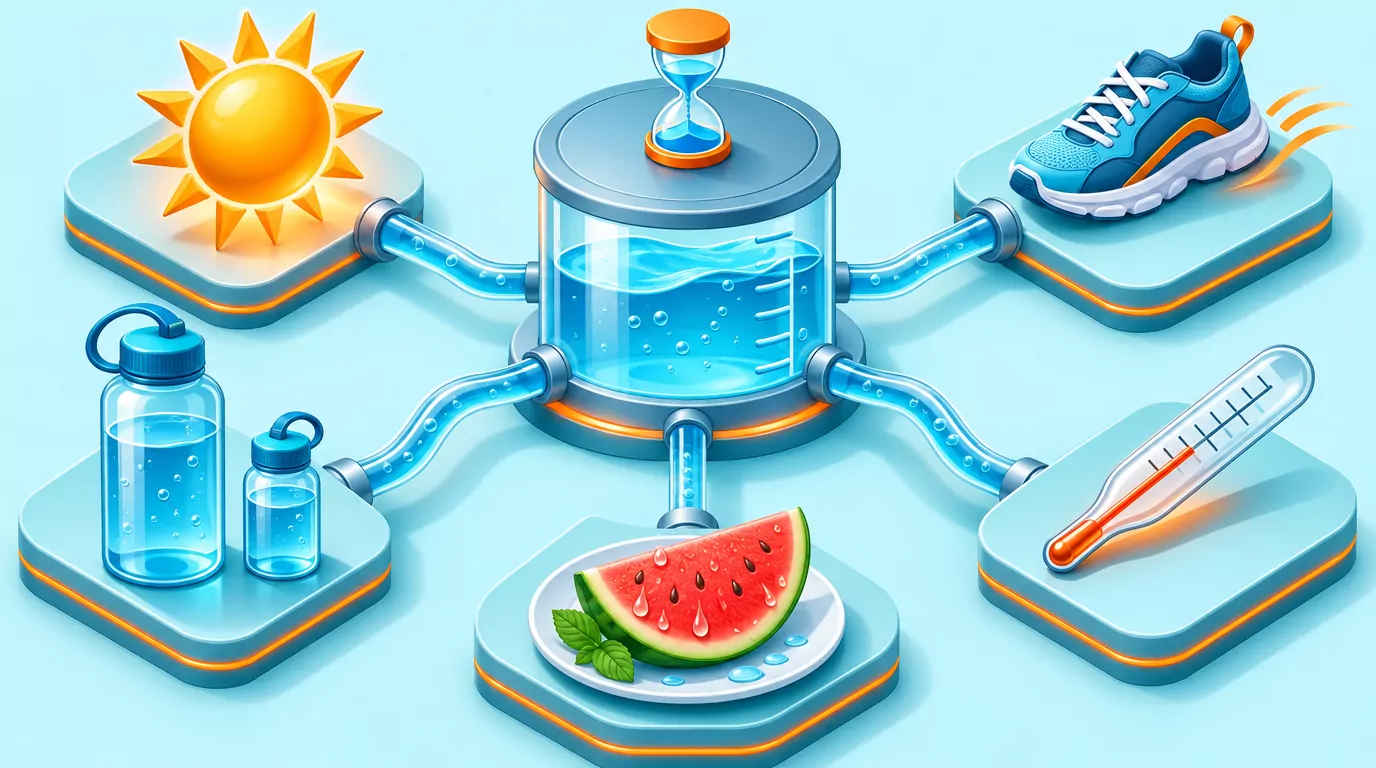
The three-day figure assumes fairly ordinary conditions. Change them, and one person's three days can be another person's afternoon. Five things move it the most:
- Heat and humidity. The body cools itself by sweating, and in extreme conditions an adult can lose 1 to 1.5 liters of sweat an hour, according to Scientific American. At that pace, a 70 kg (154 lb) adult can reach the 2% thirst stage, about 1.4 liters of sweat, within an hour or two. Hot days deserve their own plan, covered in hydration in hot weather.
- Activity. Hard effort raises sweat loss fast. Popkin and colleagues note that athletes can lose 6 to 10% of their body weight in sweat during demanding events. A sweat rate calculator shows your own loss from a weigh-in before and after a workout.
- Food. Water-rich meals stretch the window a little, while dry or salty food does not, says Medical News Today.
- Age and size. Older adults feel less thirst after going without water and drink less to make up the gap, according to Popkin and colleagues. Children overheat and dehydrate faster because their skin surface is large for their body size, Scientific American explains.
- Illness. Fever, vomiting and diarrhea raise fluid loss quickly, according to Cleveland Clinic and Scientific American. Cleveland Clinic also notes that some medicines make you pee more.
The everyday version: mild dehydration comes first
Everyday dehydration rarely gets past the first stage. It shows up on a long workday, a hot commute or a flight where drinking slips. Around the 2% mark where thirst kicks in, many people already feel tired, headachy or a little dizzy.
Cleveland Clinic puts it plainly: if you are thirsty, you are already mildly dehydrated, and the answer is simply to drink. Popkin and colleagues add that athletes' performance can dip at as little as 2%, so the gap is noticeable long before it is dangerous.
The simplest daily check is thirst plus the color of your urine. A urine color chart shows what to look for, so there is no need to memorize shades.
For a ballpark, the National Academies set adequate intakes of about 2.7 liters (91 ounces) of total water a day for women and about 3.7 liters (125 ounces) for men, from all drinks and food. They also found that most healthy people meet their needs by letting thirst guide them. For a number that fits your own body and day, the water intake calculator does the math.
If you have fallen behind, catching up is mostly steady drinking, not chugging. How to hydrate faster covers the pace that works.
The other end of the range: too much, too fast
Drinking too much is the opposite risk, and there the limit is about pace more than total. How much water is too much explains where that ceiling sits and why speed matters.
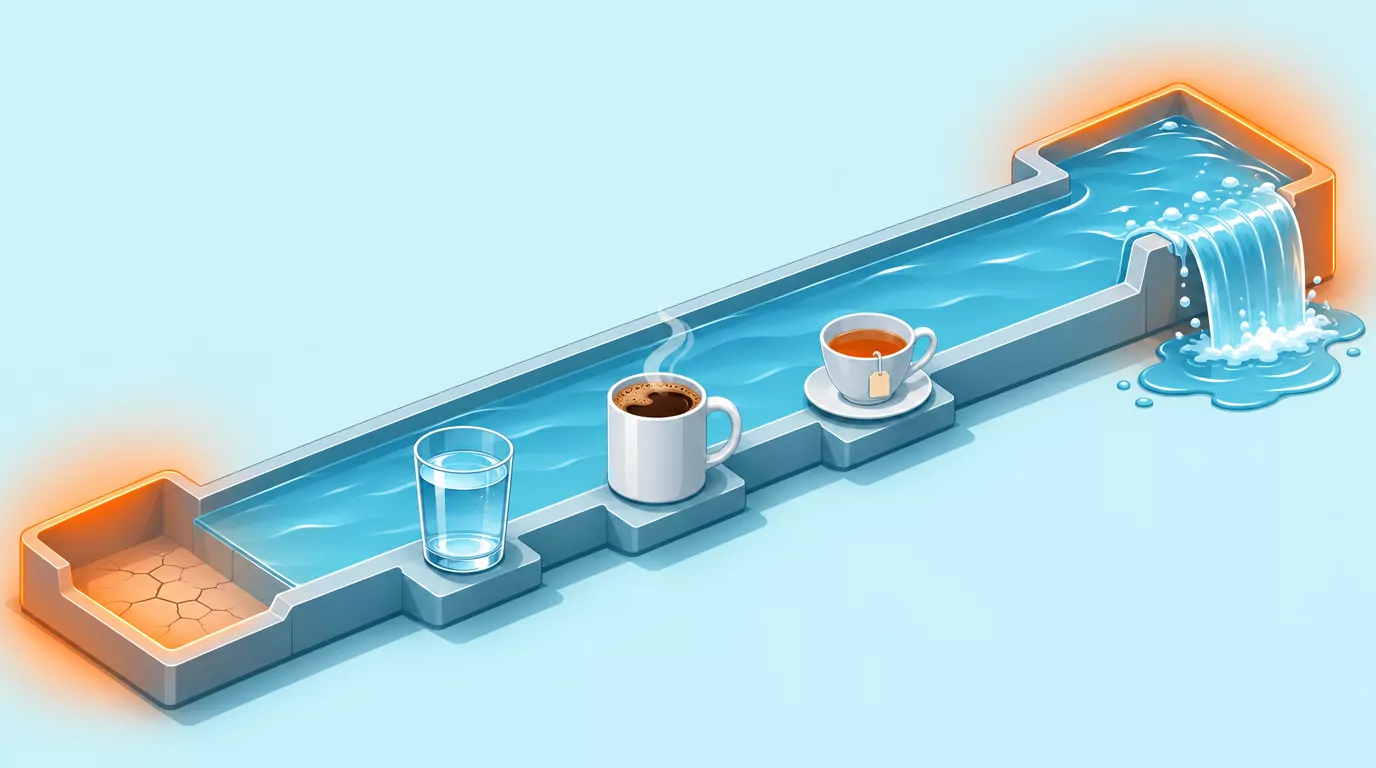
Between the two ends, the healthy zone is wide. An ordinary day of drinking to thirst, coffee included, sits comfortably inside it.
Frequently Asked Questions
What kills you first, dehydration or starvation?
Dehydration, by a wide margin. The rule of threes puts it at days without water against about three weeks without food. Water is involved in almost everything the body does, from controlling temperature to clearing waste, as Medical News Today lists, so a shortfall starts to bite within days rather than weeks.
Can you survive 7 days without water?
Rarely, and only at the far edge of the range. Scientific American's week-or-more figure assumes mild, comfortable conditions with little heat or exertion. On the rough day-by-day frame above, most people would reach the late, organ-damage stage well before then.
How long can you go without plain water if you drink other liquids?
If those drinks cover your fluid needs, you are not going without water at all. Coffee, tea and soup are mostly water, and the National Academies found that caffeinated drinks count toward total water.
How long does it take to get dehydrated?
Mild dehydration can arrive within hours on a hot day or during hard exercise, and a night's sleep alone leaves a small gap by morning. In cool, quiet conditions it builds more slowly. Thirst, a dry mouth and darker urine are the early signs, according to MedlinePlus.
Do older adults get dehydrated faster?
They can fall behind without noticing. Older adults have less body water to start with and feel less thirst, so Popkin and colleagues suggest it may be wise for them to drink regularly even when not thirsty. Hot weather adds to the risk, as the National Institute on Aging explains.
Keeping the everyday gap small
Three days is the limit nobody needs to find. The useful part of this question is the everyday gap, and a running total is the easiest way to see it. There are a few ways to keep count in how to track water intake.
Water Goose is one of them. It suggests a daily goal from your age, gender, height and weight, shown next to population reference values: a general-wellness starting point, not a prescription, and you can adjust it or set your own. Logging takes three steps (choose a drink, swipe to the amount, tap one clear button), so a drink goes in within seconds.
Water is one of 13 illustrated drink presets, and coffee, tea and soup count toward the day's total too. A today ring and a history calendar show daily totals, goal completion, consistency and streaks.
Optional reminders let you choose your active hours and frequency, then allow notifications on your device. Entries and settings are stored locally on your device, and no account is needed.
The goose would rather you never got past mildly thirsty.
Water Goose is on the App Store for iPhone and on Google Play for Android.