Sunday Reset: A Short, Calm Checklist for the Week Ahead
A Sunday reset is a short weekly routine that gets your space, food and calendar ready for Monday, so the week starts without a pile of loose ends. It fits in under an hour: clear one surface, plan a few lunches, look at the week, wash and refill your water bottle, and keep one thing just for rest.
The trend version is a three-hour vlog with candles, fresh sheets and a fridge full of matching containers. This one is built to survive a tired Sunday, a shared kitchen and a Monday deadline. The checklist comes first, and the how comes after.

What a Sunday reset is, and what it is not
A Sunday reset is a weekly look back and a look ahead. You notice what piled up last week, then turn the loose ends into a few decisions made in advance. Lunch is planned. The first task is written down. The bottle is full.
It is not a deep clean. It is not a productivity sprint, and it is not something you need to film. The goal is fewer decisions on Monday morning, not a perfect home.
Plenty of people know the low dread that shows up on Sunday evening, the one often called the Sunday scaries. A reset will not fix that, and it does not need to. It simply means that when Monday arrives, a few small things are already handled. That is a modest promise, which is the kind worth keeping.
The Sunday reset checklist
Here is the whole Sunday reset routine in seven lines. Copy it, print it, or keep it in your notes app.
- Start one load of laundry so it runs while you do the rest (2 minutes).
- Clear the one surface you meet first on Monday (10 minutes).
- Check the fridge and plan three or four lunches (15 minutes).
- Glance at the calendar and write Monday's first three tasks (10 minutes).
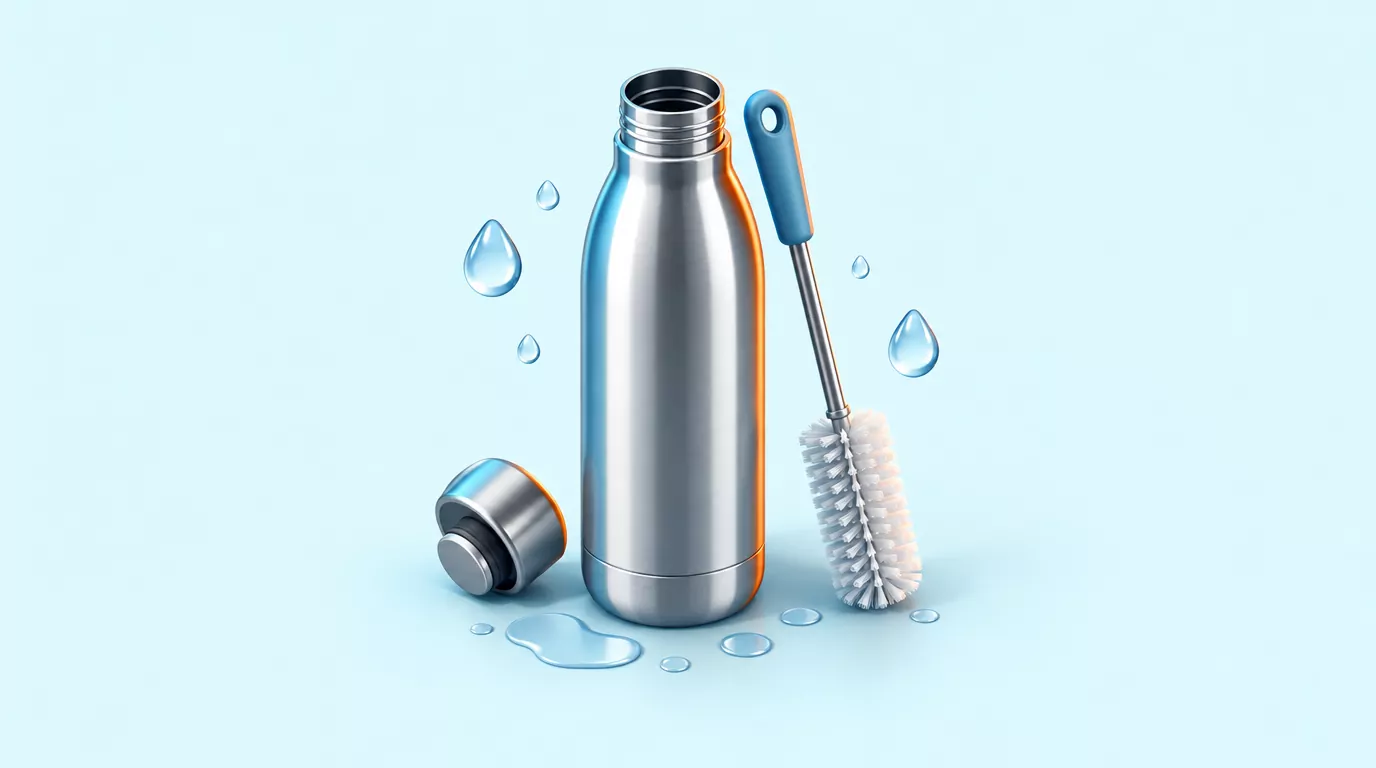
- Wash your water bottle and fill it for Monday (about 10 minutes, plus soak time).
- Pick two or three loose defaults for the week (5 minutes).
- Keep one thing that is just for rest (the rest of the evening).
| Step | What it covers | Rough time | Skip it when |
|---|---|---|---|
| Laundry | One load, started first | 2 minutes | It is not your laundry night, or the machine is taken |
| One surface | The desk, counter or table Monday meets first | 10 minutes | It is already clear (enjoy that) |
| Fridge and lunches | Bin old food, plan three or four lunches, write a short list | 15 minutes | You eat at a dining hall or work canteen |
| Calendar | Fixed points for the week, Monday's first three tasks | 10 minutes | Never, but keep it to a glance |
| Water bottle | Weekly wash, fresh refill, left where Monday starts | About 10 minutes, plus soak time | You washed it midweek; just refill it |
| Loose defaults | Two or three small decisions made once | 5 minutes | Last week's defaults still work |
| Rest | One thing that is not a task | The rest of the evening | Never |
That adds up to about 50 minutes of hands-on time, which is the point. The times are rough estimates, not rules.

How to do each step without turning it into a project
Each step below gives the minimum version first. Where there is an optional extra, there is only one.
Clear one surface, not the whole house
Start the laundry first, so the machine works while you do. Then pick the surface Monday meets first: the desk, the kitchen counter or the table by the door.
Set a ten-minute timer. Put things back where they live, bin the rubbish, and stop when the timer stops. Mugs go to the sink, papers go in one pile, and chargers go back to their spot.
Room-by-room reset lists often run 90 minutes or more. That is fine on a free Sunday, but it is not the minimum. One clear surface gives Monday a clean place to land, and it is small enough to finish even in a shared flat where the rest of the mess belongs to someone else.
Check the fridge and plan three or four lunches
Bin what is past it, then look at what is already there. Plan lunches around those leftovers and half-used packs, and write a short shopping list for the gaps.
Plan three or four lunches, not five. The USDA guidance on leftovers says cooked leftovers keep in the fridge for 3 to 4 days, or in the freezer for 3 to 4 months. So freeze the late-week portion, or plan to buy lunch that day. While the door is open, the FDA advises keeping the fridge at or below 40°F (4°C).
If plain water is the hard part of your week, a jug of cucumber water made tonight is an easy start for Monday.
Glance at the calendar and write Monday's first three tasks
Look at the week's fixed points: classes, deadlines, shifts and appointments. Then write Monday's first three tasks, and make them specific. "Send Sam the draft by 10" works. "Work stuff" does not.
If a commitment does not fit, decide tonight whether to move it or drop it. Saying no to a few things is a bigger topic, covered in this guide to simple living.
There is a small piece of research behind the habit. In a 2011 lab study by Masicampo and Baumeister, making a specific plan for an unfinished goal reduced how often that goal intruded on people's thoughts. It is one study, not a promise, but it fits a common experience: a task written down with a time attached tends to nag a little less.
Wash your water bottle and fill it for Monday
The weekly soak is the one bottle job that needs a slot, and Sunday is a good one. The full method is in how to clean a water bottle, so it does not need repeating here.
Once it is clean and dry, refill it with fresh water instead of topping up whatever has sat there since Thursday. Flat is not the same as off, and this explainer on whether water expires covers why. Fresh water simply tastes better, and better-tasting water is easier to drink.
Then leave the bottle where Monday starts: by your keys, in your bag, or on the desk you just cleared. A full bottle in plain sight does more for the week than a good intention does.

Pick two or three loose defaults for the week
A default is a decision made once on Sunday, so you do not make it every day. Good ones are small: a glass of water with breakfast, a refill on the way back from lunch, the bottle on the desk before the first meeting or lecture.
Tie each one to something that already happens in your week, such as breakfast or the walk back from class. For a sample day built this way, see this drink water time table. If you want a daily number to aim for, the water intake calculator gives a starting point.
Keep it to two or three. Five defaults is a new rulebook, and rulebooks rarely survive Wednesday.
One line on your phone: if it was loud all week, tonight is not the night for a full clean-up. The guide to too many notifications has a better plan for that, including a monthly re-audit.

Keep one thing that is just for rest
One item on the list is not a task. It can be a walk, a bath, a call with a friend, a film, or nothing at all. It does not need to be productive or photogenic.
The rest item is what makes the rest of the list worth doing. Without it, a Sunday reset is just a second Monday that starts early.
One small, practical note: try to keep Sunday's bedtime close to a weeknight one. The CDC's sleep tips suggest going to bed and getting up at the same time every day.
The 15-minute Sunday reset for weeks that got away from you
Some Sundays the full list will not happen. That is fine. Here is the minimum version:
- Bottle (5 minutes): rinse it and fill it with fresh water. Skip the soak this week.
- Tasks (5 minutes): write Monday's first three tasks, without the full calendar look.
- Surface (5 minutes): a five-minute timer on the one surface Monday meets first.
That is all. These short versions shrink the same steps instead of adding new ones, so nothing new needs remembering.
The short version done most weeks beats the full version done once. A skipped week is not a failure either. It is just a week.

Making the reset stick without making it a streak
The easiest way to keep a weekly reset is to tie it to something that already happens on Sunday evening: after dinner, while the laundry runs, or before the call home. Keep the same order every week, so it needs no thought. Keep it small enough to finish on a bad week.
Be patient with it. A weekly routine gets far fewer repetitions than a daily one, so it takes a while to feel automatic. How long it takes to form a habit explains why the timeline varies so much.
It also helps to judge the habit on a weekly scale. The idea of reviewing weekly, not hourly, from this piece on hydration streaks fits a reset well. Missing one Sunday does not undo the others.
If you like seeing the week's water on paper, the printable water tracker builds daily, weekly or monthly sheets with no sign-up. You do not need a reset app, a planner or anything else to buy.
Frequently Asked Questions
Is a Sunday reset the same as self-care Sunday?
Not quite. Self-care Sunday puts rest first, while a reset is mostly logistics with one rest item built in. They overlap, and many people do both. A reset is judged by how Monday morning goes, not by how relaxing Sunday felt.
Does a Sunday reset have to happen on a Sunday?
No. Do your weekly reset the evening before your week starts. That might be Saturday if you work weekends, or the night before a new term or shift pattern. Some people clear the desk on Friday afternoon and do the rest at home.
What if the week falls apart by Wednesday?
A ten-minute midweek reset is enough. Rinse and refill the bottle (2 minutes), rewrite the next three tasks (3 minutes), and give the one surface a five-minute sweep. Do not redo the whole Sunday list. Pick up from the next fixed point in the week.
Is a Sunday reset actually a thing, or just a trend?
Both, really. "Sunday reset" (or "reset Sunday", both word orders are used) is a trend name for a plain weekly habit: look back at the week, then set up the next one. You need none of the aesthetic version for it to work.
How do you reset for the week?
Look back before you look ahead. Note what spilled over from last week, and carry at most one unfinished thing into Monday. Anything bigger goes on the calendar for a real slot, instead of being squeezed into tonight.
Start Monday with the bottle already full
The reset fills the bottle. The week still has to drink it, and that is the part Water Goose keeps small.
The app suggests a personal daily goal from your age, gender, height and weight, shown next to population reference values. Logging takes three steps: choose a drink, swipe to the amount, and tap one clear button. Coffee, tea, soup and other everyday drinks all count toward the day's total.
The history calendar shows daily totals, goal completion, consistency and streaks. So a Sunday glance at last week shows which days ran dry, without a lecture. Reminders are optional: you choose your active hours and frequency, then allow notifications on your device. Entries and settings are stored locally on your device, and no account is needed.
Hydration needs vary with health, activity and weather, so treat any goal as a general-wellness starting point, not medical advice.
Fill the bottle on Sunday, and let the goose keep count from Monday.
Water Goose is on the App Store for iPhone and on Google Play for Android.